Saturday, 16 January 2016

Tongariro National Park


Our hotel - Bayview Chateau for 2 nights right in the National Park.

On Thursday we split up into 2 groups.  11 of us chose to do the all day hike - Tongariro Crossing, while the others did two smaller hikes with lunch at the hotel. Our bus drove us to the start of the hike and we started hiking at 8:15am.  

The hike is basically a walk up to the ridge of a volcano, down into the inside of the crater and across to the other side then back up to the ridge.  Along the ridge then up to the summit, along the ridge above the red crater, back way down a hill to the Emerald Lakes (3), across the next crater to Blue Lake, up the side of the crater, then down, down and down some more until 8 hours later we came out to the parking lot where our bus was waiting for us.

Tongariro Crossing is considered the best one day hike in New Zealand, at 19.4km long with 2,550 ft of ascent and 3,700 ft of descent.  The considerable up was pretty difficult and we were very lucky with the weather as it was cloudy, no rain and only a little bit of wind.  Not too hot, in fact I was quite chilly when we got near the summit.  It definitely cooled off as we got higher. 


Looking back where we had come from. 

Crossing the inside of the south crater.
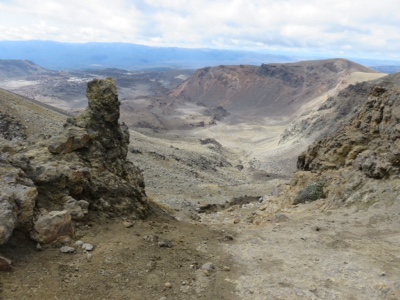
Looking back again after finishing a scramble.

Mt. Ngauruhoe or more commonly known as Mt. Doom in the Lord of the Rings movies.

The Red Crater which looks like the Orcs will be flying out of it at any moment.

Our group.

Going down to the 3 Emerald Lakes

The Blue Lake with an alpine daisy in front.

On our way down from the craters.

The view as we head down.

Finished! Whew, we were exhausted but elated to have done the hike.


Friday, 15 January 2016

Letting Off Steam


Te Puia is the shortened version of Whakarewarewa Thermal Village just on the way out of Rotorua.  We spent an hour and a half there with a great interpreter, Carla.  She explained so much about Maori village structure, how the different tribes arrived in New Zealand and where they were from originally.  This village was always the home land of her tribe, (shark in English) who originally came from Tahiti.  They considered themselves very lucky to end up with this land with hot and cold running water!!!   There are geysers and mud pools throughout their village land and they have been able to capitalize on tourism ever since they came and so have always been self sustaining.  


An important part of this centre is the wood carving school where students are taken in as apprentices for two years, and taught to be carving instructors, with the understanding they will return to their own villages to pass on the skills. 


Weaving flax is a very important craft for the Maori.  They grow the flax commercially.  It is used for weaving baskets, making ceremonial skirts and costumes, clothing, many different things. There's also a weaving school here. 


This geyser goes "off" about once an hour and does its thing for 20 minutes then is quiet until the next time. It has its own schedule so when it's starts to go tourists rush to the fence to watch.

Boiling mud flats. Wish we could have included the sound with this photo!

We left after an attempt to visit with 2 kiwi birds who live in a special building that visitors can enter. They did not think we were interesting enough to poke their heads out of their hiding places.  The house is quite dark inside as they are nocturnal birds.  No luck today for us.  Apparently they are not easy to see out in the wild or in captivity.  They do not fly but walk around in the undergrowth much the same color.

Our bus took us down to Tongariro National Park to our hotel, the Chateau.  Dorothy told us it was faded grandeur but we thought it quite lovely - except for the Internet!!  We got there just after five and had until 7 (till dinner time) to get organized to leave at 7:30 tomorrow morning for our big hike.  

Dinner was very good and quite elegant, but took a very long time to arrive at our table.


Judy and I both had the wild boar and venison pate for starters while Wendy had the shrimp.  Both delicious.

Main course was pork with bacon.  Very nice.

But of course my favorite part was dessert - a lemon brûlée pie.  It was heavenly.

Tomorrow the big hike.  Stayed tuned!!


Maori Hangi or Feast!

The night we were in Rotorua we were picked up by bus from the Tamaki Maori Village, about 15km south of Rotorua.  The bus driver was part of the entertainment as he welcomed everyone onto his bus in at least 40 different languages.  One of his first jobs was to make sure we learned all the Maori greeting of Kia Ora. He talked all the way to the village and all the way back and he sang too. 
The experience was quite similar to a Hawaiian Luau.


Entrance to Maori Village.

Dinner has just been dug up from the Hangi (earthen pit) and was then served buffet style.  

We had white fish done in a sauce, lamb and chicken.  All of them delicious.  There were big bowls of potatoes and kumara (a Maori staple, root vegetable similar to sweet potato), carrots, stuffing, cranberries, a mint sauce and a round bread.  Dessert was a hot chocolate sponge pudding and pavlova with fruit.  

Some of the visitors (males only) being taught the Haka, Maori war dance. Note two young boys beside their dad - having such a good time.

Two of the Maori dancers showing their battle face, meant to terrify the enemy.

It was a fun evening that we all enjoyed.  

Kia Ora!


Symbols of New Zealand

The Maori call this fern frond Koru, the symbol of new life unfolding.

Today was all about volcanic activity in and around Rotorua and the effect it has had.  We left the hotel and headed to meet our local guide to hike through Waimangu volcanic valley. We spent the morning hiking down through the valley past many sulfur pools, steam vents and lakes.  It was interesting to hear about the flowers and shrubs of the region but also about the type of water fowl that can hang out around these very acidic water sources.  We could not swim or even paddle in this mucky looking lake. Apparently some days it is quite green; it depends on what kind of volcanic action is happening that day. Many places we could feel the heat in the rocks.

Bubbling mud ponds (not good for a nice mud bath as you would just keep sinking as in quick sand).

Lots of different colors show the types of elements present: iron, magnesium, sulphur, etc.

Steam vents above another lake. We could smell the sulfur in the air. 

After our walk we had a boat ride across Lake Rotomahana then hiked up and over a bit of a hill that was full of ferns of all sizes.  Have never seen a fern tree before.


And we learned about the silver fern, the New Zealand national symbol. This is the underside of the fern frond. New Zealanders are currently considering a new flag, and one option shows an image of the silver fern. 

Another boat ride across an even bigger lake, Lake Tarawera, brought us to our lunch and coffee break before heading on to our next stop - The Buried village. Even 120 years ago tourists were exploring these areas. An eruption in 1886 dramatically changed the landscape and buried several Maori villages, killing 150 people. 


The museum was very interesting and then we did a walk through the buried village.  The highlight for me was the walk to the waterfalls. 

Wendy and Judy.


We later had a walk in a redwood forest in the rain before heading back to the hotel. Loved it!

Kia Ora


Tuesday, 12 January 2016

On to Rotorua

Our group left Auckland with Steve, our driver, getting us out of the morning business traffic fairly quickly. Headed south for about 1.5 hours to Hamilton where we went to visit Hamilton Gardens. Although not high on the official tourist lists of things to do, it certainly should be. And it is free - what's not to like about that? It has a large number of demonstration gardens over quite an extensive area. They illustrate ornamental gardens as developed at different periods and by different cultures: an English Flower Garden, Chinese Scholar Garden, Japanese Meditation Garden, Indian Char Bagh Garden, Italian Renaissance Garden. We also saw a Tudor box-hedge one, and a typical Maori kitchen garden.  We saw only a small part of the whole project in an hour and a half visit. It was an excellent walk around.  


After we left the gardens we drove on a bit before stopping for lunch in a small town then heading to see the glo-worm caves at Waitomo. No photos allowed until the very end but I didn't want to miss anything with my eyes.  A fun highlight was to sing The Happy Wanderer deep inside the cave in a space named the Cathedral.  Our leader had asked our group if that was possible and it turned out Robert is a member of a choir in England so he suggested the song and I think we did a fine job.  Sounded very cool anyway.


We went through the caves with a guide so we heard much about the history of the caves and about the actual glo-worms.  The walking part of the trip is through the caves that have very low subtle lighting so you can't see the glo-worms but you can see where you are going.  Near the end of the walk the guide takes the group down to a spot where you duck down and look under an overhang and it's unbelievable!  Each little worm casts a greenish light, and there are thousands all over the ceiling of the cave.  We could even see the hair like strings hanging from each worm that they use to catch their dinner.  Each worm has about 40 strings of different lengths. They glow to attract other insects and even the adult fly which then stick to the threads and the glow worm can wiggle down to eat their dinner.  At the end of the walk we all climb into a boat and the guide pulls us along on overhead wires.  It's a silent boat ride, no talking.  It was quite magical with the millions of glow worms glittering the rocks above our heads like the the night sky and stars.  We could see no other lights.  We all decided it takes a special person to be able to pull the boat through the caves in the dark while standing on the bow in absolutely the silence.  


Judy getting out of the boat at the end of our tour with the guide dressed in black with her back to my camera.

Our day continued on to the town of Rotorua where we would spend the next two nights.  Rotorua is built inside the crater of the volcano.  For many many years it has been a major tourist attraction for the geysers, boiling mud pools as well as the healing proprieties of the hot water under the surface.  Tomorrow we will explore.

Apologies to all Aussies reading this blog.  Pavlova is an Australian dessert that is served in New Zealand, not the othe way around.

Cheers!


Monday, 11 January 2016

Rangitoto

Sunday - our first full day with the group, saw us heading out of the hotel at 8:20 to walk down to the waterfront for our ferry ride over to the island of Rangitoto.  This island is a park within the Hauraki Gulf and it is the newest volcanic island.  It erupted out of the sea only 600 years ago.  The name Rangitoto means bloody sky in Maori.  


Our guide, Peter met us at the waterfront as we boarded the ferry to get to the island.  It was about a 25 minute ride.  We had a gorgeous day for the trip even though it was a mix of some sunny periods, some cloudy periods and a touch of rain.  The good thing was it was not too hot as the island is all volcanic rock and apparently there can be very hot reflection off the rock.  Peter gave us a fascinating walk, explaining much about the history of the island, the shrubs and trees and how awful a scourge the possum has been to the island.  It is now possum free but now has a problem with feral cats.  

We did a hike to the summit with a side trip to the lava caves.  Peter stopped along the way to point out various ferns, shrubs, trees and flowers.  The island is home to the largest Pohutakawa Forest in New Zealand or commonly known as the New Zealand Christmas tree because of the bright red flowers that bloom in December.  


Even though the hike was only just over 5 km it was a good hard hike going up.  Lots of stairs and rough rock underfoot.  We had our picnic lunch up at the summit with its gorgeous 360 degree views.

The lava caves were quite tricky walking through as the ground was very uneven and it was very dark.  There are a couple of caves on the island but Peter felt the one he took us into was the most interesting.  

In one side and then out the other.


That night we had dinner again at the hotel.  I had the Snapper for dinner which I thought was quite good.


Dessert was chocolate mud cake which was not bad at all.  

The night before we had steak for dinner but I forgot to take the picture.  Then dessert was pavlova, a New Zealand classic.  It was very good.


Tomorrow we leave early to drive down to Rotorua with some good stops on the way but no big hikes.